work / 2sl stab
2sl stab
A chord instrument for Ableton Live. Hold one key and it plays the whole chord, or play single lines, with a stab sequencer and an echo built in.
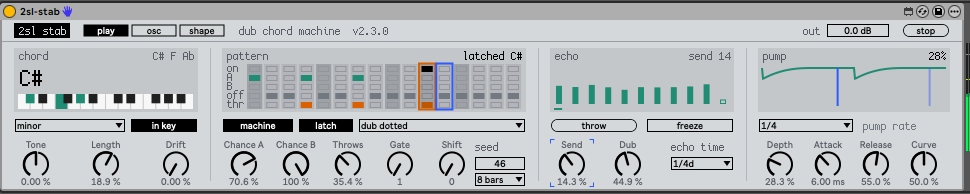
what it does
A Max for Live instrument for dub techno chords. Play chord clips straight through it, or hold one key and it plays the whole chord, the old chord memory trick. The synth is a polyphonic analog-style voice laid out like a Juno or Jupiter. A 16-step machine plays stabs off a latched chord, and the dub moves are right there to perform: throw, freeze, echo send and pump.
There are three pages, play, osc and shape. Each section has a small display showing what it's doing. The controls are normal Live controls, so automation, mapping and Push all work.
play
| chord | the chord you're playing, on a lit keyboard. Chord type (held notes, minor, m7, m9, m11, sus4, fifths, dark), In Key to follow Live's Scale Mode, tone, length, and drift, which changes the voicing a little each stab |
|---|---|
| machine | 16 steps, each one on, A, B or off. Chance A and Chance B set how often the A and B steps play. Mark steps in the throw row and their stabs go into the echo, as hard as Throws says. Latch, pattern, gate and shift. Seed and Loop make the chances repeat, so a part plays back the way you heard it. Steps save with the set. |
| dub | the echo, with its last ten repeats drawn as they actually sounded. Dub (feedback), throw, freeze, time and send |
| pump | a duck synced to Live's tempo. Depth, attack, release, curve and rate |
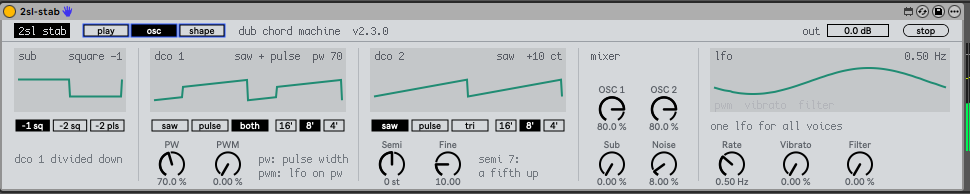
osc
| sub | a square 1 or 2 octaves down, or a 25% pulse 2 octaves down, following dco 1 |
|---|---|
| dco 1 | saw, pulse or both at 16′, 8′ or 4′, with PW and PWM for the Juno shimmer |
| dco 2 | saw, pulse or tri, up to an octave either way (7 semis stacks a fifth), plus fine detune |
| mixer | OSC 1, OSC 2, Sub, Noise |
| lfo | one for all voices: rate, vibrato and filter |
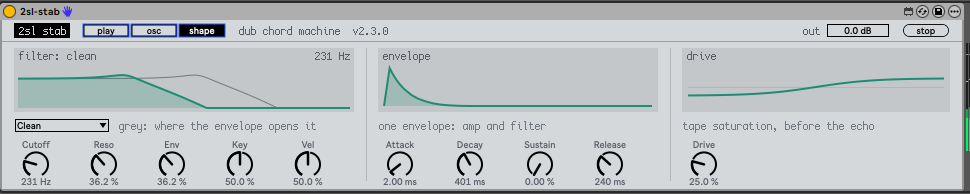
shape
| filter | a 24 dB ladder low-pass, with the envelope's sweep shown in grey. Filter type picks clean or Moog, a transistor ladder that sings from about 75% reso like a Minimoog. Cutoff, reso, env, key and vel |
|---|---|
| envelope | one ADSR for amp and filter |
| drive | tape saturation before the echo. Turning it up adds grit without making it louder |
The signal goes oscillators → filter → saturation → echo. The output is clean, with no clip of its own, and the presets peak under full scale.
stop
Stop, top right, is a panic button. It kills every note, clears the latched chord and empties the echo. Stopping Live doesn't do that, so tails ring out like any instrument and a latched chord comes back when you hit play. With Live stopped, the machine only plays while you hold keys, so you can audition sounds.
presets
Init plus 24 sounds, saved as normal Live presets you can browse and hot-swap from the browser or Push. They're volume matched, so nothing jumps when you switch.
| dub | chain stab, m-stab, deep haze, fog, wash, skank, roots chop, sub stab, tape chord, ambient dub, throw dub, moog sing |
|---|---|
| techno | hypnotic loop, dark machine, chord memory, warehouse, pulse, rolling, dark fifths, throw machine, moog chords |
| other | detroit strings, deep house keys (made for chord progressions' clips), pump pad |
install
It's coming to the 2sl shop, as the Max for Live device and as a VST3. Once it's out, here's how to install the device:
- Unzip the download.
- Move the folder inside into User Library/Presets/Instruments/Max Instrument/.
- In Live's browser, drag the .amxd onto a MIDI track. The presets are in the same folder.
Keep the presets next to the .amxd and don't rename it, or the presets won't find it.
Needs Live Suite, or Standard with Max for Live. Live 12 is best. 11.1 works too, minus In Key.
what it's based on
Classic dub techno sound design: the minor stab, chord memory on one key, saws and a bit of noise into a dark 24 dB low-pass, detuned oscillators, filtered tape echo, sidechain pump, and voicings that drift like Kerri Chandler's.
how it's built
The patch is generated in Python with our open source kit, 2sl-dsp. The voice and echo are gen~, and the chords, sequencer and displays are JavaScript. The build fails if a change would break saved sets, presets or automation. The displays use 2sl-ui, the same design system as this site, and follow Live's light or dark theme.
We take commissions like this. The first 30 minutes are free: book a consultation or get in touch.
next projectlpx grid